Dog Training Basics: Loose-Leash Walking and Four Core Cues
Dogs learn what pays. Almost all modern training rests on that one idea: mark the moment the dog does the right thing, pay them for it, and repeat it until it's a habit. No shouting, no dominance theatre.
Five minutes twice a day beats an hour on Sunday. Dogs, like people, learn better in short, frequent, cheerful bursts.
What you'll need
- Small, soft, high-value treats cut tiny
- A treat pouch
- A 6-foot flat leash and a well-fitted harness
- A quiet space with no distractions to start in
Mark, then reward
Pick a marker — a clicker, or a crisp word like 'yes'. The marker's job is to say 'that exact thing you just did earns a treat'. Timing matters far more than the size of the reward: mark the instant the behaviour happens, then deliver the treat within a second or two.
Spend the first day just building the association: say 'yes', give a treat, twenty times, asking for nothing. After that the marker has meaning and you can start teaching.
The four cues worth having
- 1Sit — hold a treat at the dog's nose and move it slowly back over their head. As the bottom drops, mark and reward.
- 2Down — from a sit, lower the treat straight to the floor between their paws. Mark the moment the elbows touch down.
- 3Come — say the word once in a happy tone, run backwards a few steps, and pay generously when they arrive. Make coming to you the best thing that happens all day.
- 4Stay — ask for a sit, wait one second, mark and reward. Build to two seconds, then three. Add distance only after duration is solid.
Tip: Never call your dog to do something they dislike — a bath, a nail trim, going home from the park. Go and get them instead. One bad association can undo months of recall training.
Stop the pulling
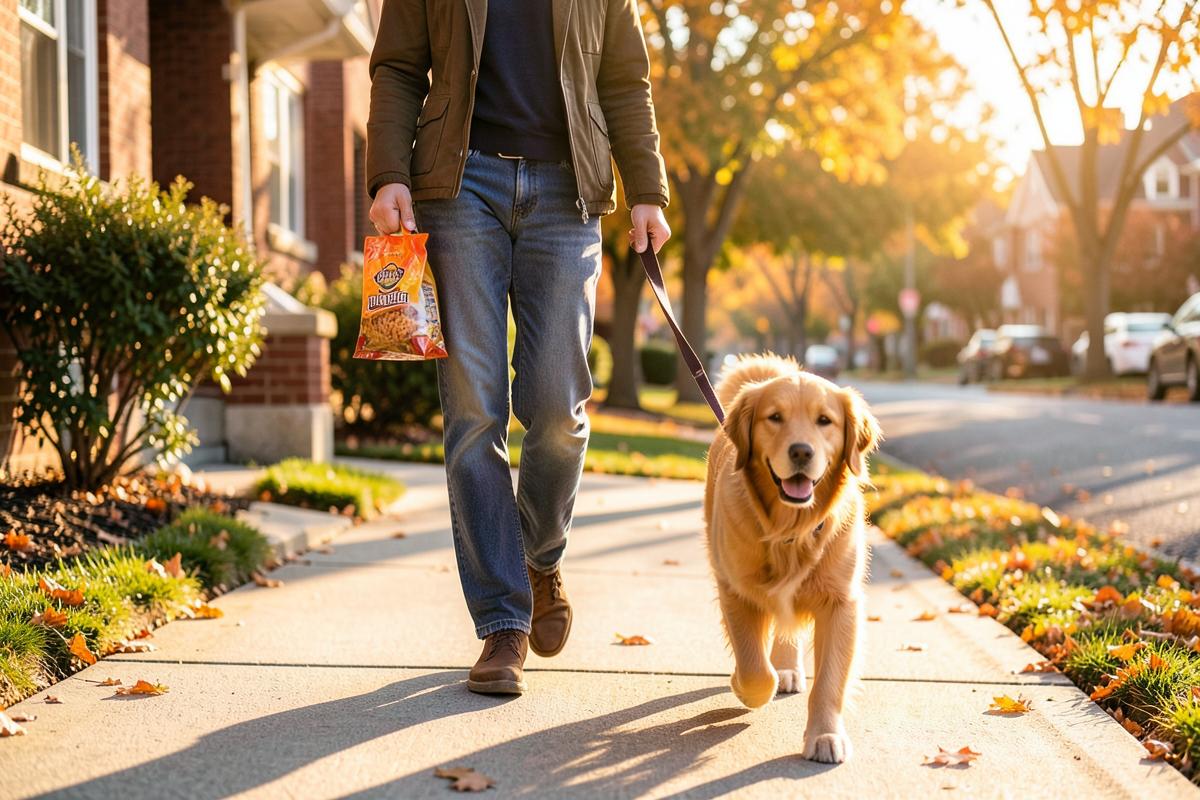
Dogs pull because it works: they pull, and the walk continues in the direction they wanted. The fix is to make pulling stop the walk entirely. The moment the leash goes tight, stand still. Say nothing. Wait. The instant there's slack, mark, reward, and walk on.
The first few walks will be slow and faintly ridiculous — you may cover fifty yards in ten minutes. That's the training working. Within a week or two, most dogs work out that a loose leash makes the world move.
- 1Use a front-clip harness while you train — it removes leverage without hurting the dog.
- 2Reward heavily whenever the dog is beside you and the leash is slack.
- 3Change direction when they forge ahead so following you becomes the interesting choice.
- 4Give a sniff break on cue — sniffing is genuinely tiring and satisfying for a dog.
Proof it in the real world
A dog that sits perfectly in your kitchen may have no idea what 'sit' means in a park, because dogs don't generalise the way we do. Practise every cue in three places, at three distraction levels, before you expect it to hold outdoors. Raise one difficulty at a time: distance, duration, or distraction — never all three at once.
Fading the treats
You won't be carrying liver forever. Once a behaviour is reliable, move to rewarding intermittently — an unpredictable payout is actually more motivating than a guaranteed one. Then start paying with life rewards: the door opening, the ball thrown, the greeting they wanted.
When to get help
Growling, snapping, guarding food, or serious fear are not stubbornness and shouldn't be trained out with confrontation. A qualified reward-based behaviourist is the right call, early rather than late.
Common mistakes to avoid
- Repeating a cue five times, which teaches the dog it means 'eventually'.
- Training sessions that run long and end in frustration.
- Using treats so large the dog fills up in ten reps.
- Punishing after the fact — dogs don't connect it to something they did earlier.
Want someone to show you?
A trainer watching one walk on video usually spots the problem straight away. Kindlio has trainers doing live sessions with you and your dog.


